Salvage rules: No special treatment
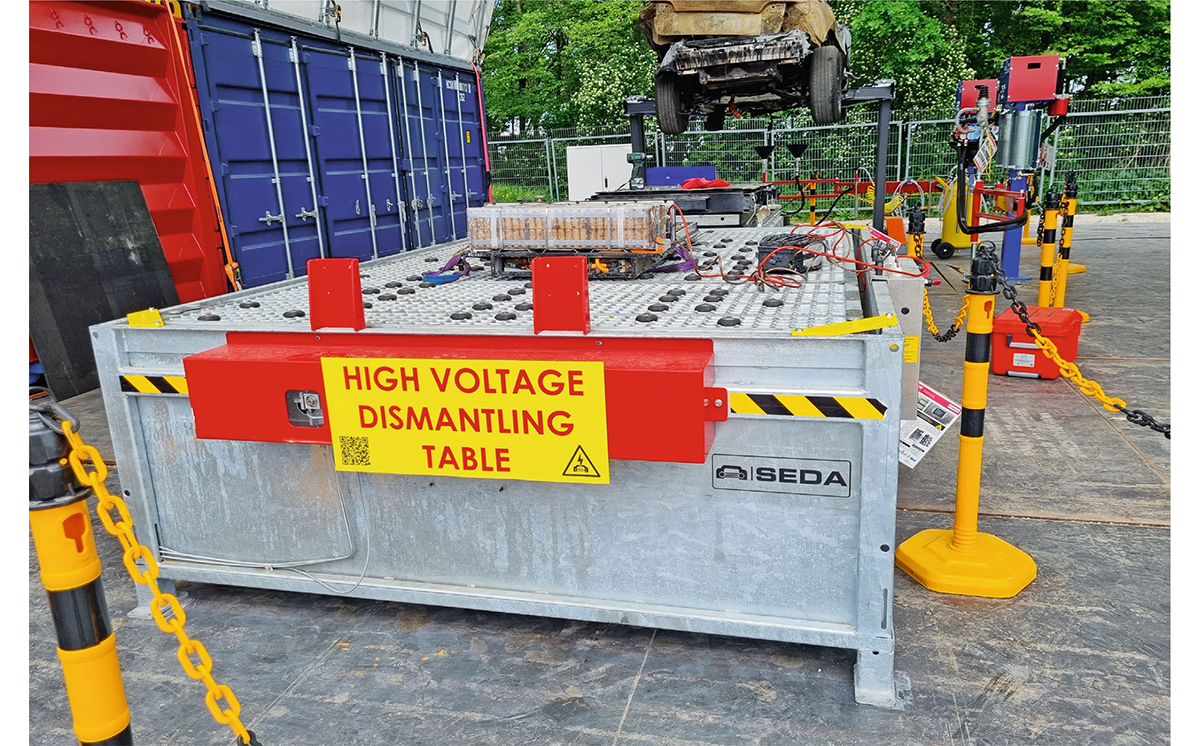
A high-voltage battery may only be removed in a qualified car repair shop.
©Foto: D. Schulte-Brader | TECVIA Media GmbHUnlike a wrecked car with an internal combustion engine, special measures only need to be taken when recovering wrecked vehicles with electric drives if the high-voltage system is damaged. These measures are described in detail in the new joint ‘Recommendations for the recovery, towing and transport of electric vehicles involved in accidents’ published by the ADAC, the automotive industry, insurers and fire services.
First steps
Responsibility for a vehicle involved in an accident is initially assumed by the fire brigade, who are alerted and carry out a risk assessment. Here, a decision is made as to whether additional safety measures need to be taken, such as putting on personal protective equipment. In the event of bodywork damage, there is generally no risk of electric shock. In the event of a serious accident, possibly involving airbag deployment, the high-voltage system in most vehicles is automatically switched off. The so-called galvanic isolation of the bodywork and the high-voltage components generally prevents the risk of electric shock when touching the bodywork. As a general rule, high-voltage cables that have been damaged and exposed in a crash must not be touched.
Observe the condition of the accident vehicle
If the energy storage device of the accident vehicle is damaged and/or fluid is leaking from the battery, watch out for heat, gas and smoke development as well as hissing or cracking noises. If the temperature continues to rise, it is recommended that the emergency services cool the battery storage housing with water. Cooling with water is also advisable in the event of a gas-emitting power storage device. Caution: Electric cars involved in accidents with battery damage may still catch fire in the days following the accident.
Towing procedure
If the damage is minor and the fire brigade classifies the electric vehicle as safe, the ‘normal’ towing procedure can be carried out. However, this involves general work on electric vehicles and requires the qualification of ‘competent person’ (FuP) in accordance with DGUV Information 209-093. The towing service must take the damaged electric vehicle to the nearest specialist car repair shop qualified to work on electric vehicles. Only there can an high-voltage battery be professionally removed, not at the scene of the accident. The transport task of the towing company ends with the handover of the towed vehicle to the workshop, including a handover report. It is recommended that all parties involved receive and keep a copy of the handover report.
Workshop expertise
In order to repair an electric vehicle in a workshop, employees must be appropriately trained. DGUV 209-093 distinguishes between the following qualification levels:
S: Sensitised person: Operation of vehicles, such as changing windscreen wiper blades, refilling windscreen washer fluid, etc.
1S: Competently instructed person (FuP): General work such as bodywork, wheel changes, etc.
2S: Competent person (FHV) for work on HV systems in a de-energised state; repair, replacement, testing, etc.
3S: Competent person for work on live HV components; troubleshooting and replacement of components under voltage
Conclusion
Based on experience to date, electric cars are just as safe as conventionally powered vehicles and can be handled and transported safely even in the event of an accident. In the event of damage to the energy storage system, it must be ensured that responsibilities are clearly defined and that emergency services and workshop staff have the appropriate qualifications.
Thomas Maier
© Copyright 2026 Gefahrgut-Online

Diskutieren Sie mit