Zelle und Batterie: Formate und Definitionen | Cell and Battery: Formats and Definitions
Die heute am häufigsten produzierten Lithiumzellenformate sind:
- Zylindrische Zellen
- Pouch-Zellen
- Prismatische Zellen
Je nach Format liegt die Kapazität bei 2-3 Amperestunden (Ah), 20-40 Ah oder 100-300 Ah. Die Batteriegröße liegt bei unter zwei Kilowattstunden (kWh), 2-10 kWh oder mehr als 10 kWh. Wo liegt nun der Unterschied zwischen einer Zelle und einer Batterie?
Zelle
Eine einzelne ummantelte elektrochemische Einheit (eine positive und eine negative Elektrode), die zwischen ihren beiden Polen eine Spannungsdifferenz aufweist. Ist diese Definition im Sinne der UN-Modellvorschriften und des Handbuchs Prüfungen und Kriterien der UN erfüllt, gilt die elektrochemische Einheit als Zelle und nicht als Batterie, ungeachtet dessen, ob diese Einheit ansonsten als Batterie oder einzellige Batterie bezeichnet wird.
Knopfzelle
Eine runde, kleine Zelle, deren Gesamthöhe kleiner ist als ihr Durchmesser.
Einzellige Batterie
Eine einzellige Batterie wird als Zelle betrachtet und muss gemäß den Prüfanforderungen für Zellen geprüft sein.
Batterie
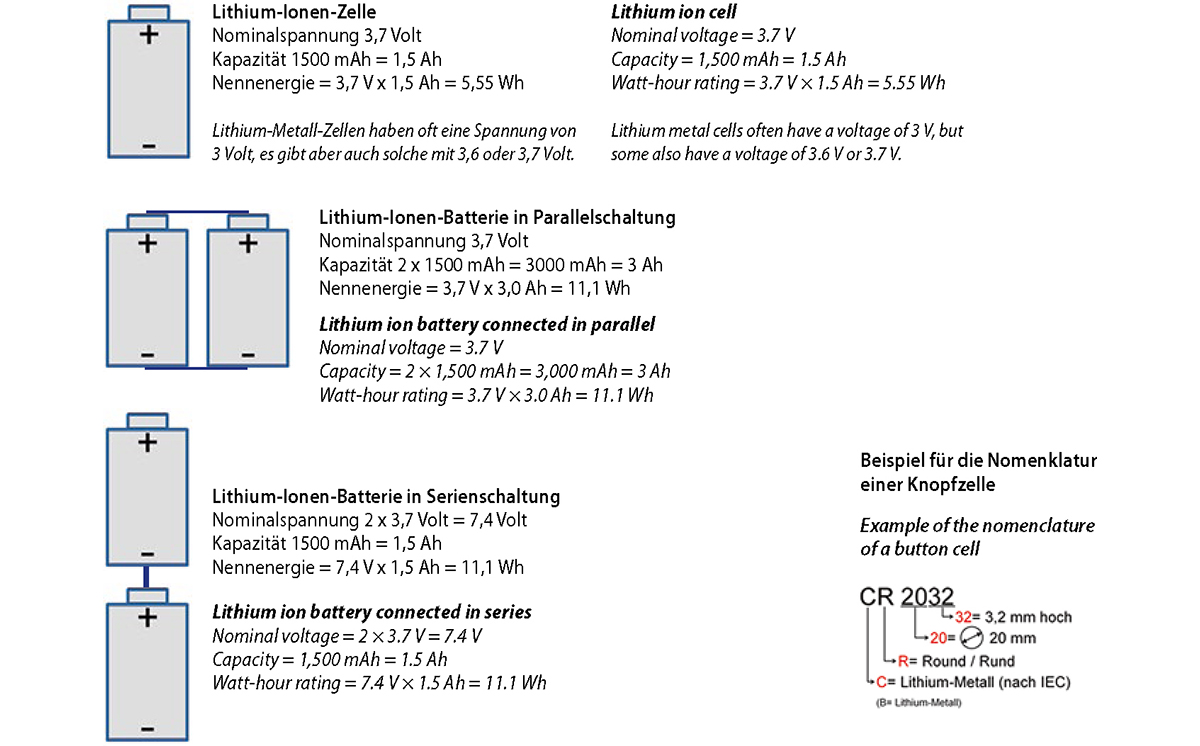
Zwei oder mehr Zellen, die elektrisch miteinander verbunden und mit für deren Gebrauch notwendigen Vorrichtungen ausgerüstet sind wie Gehäuse, Anschlüsse, Kennzeichnungen und Schutzvorrichtungen.
Daniela Schulte-Brader
The most common lithium cell formats produced today are:
- Cylindrical cells
- Pouch cells
- Prismatic cells
Depending on the format, the capacity is 2-3 amp-hours (Ah), 20-40 Ah or 100-300 Ah. Battery size is less than two kilowatt-hours (kWh), 2-10 kWh, or more than 10 kWh. So what is the difference between cell and battery?
Cell
A single encased electrochemical unit (one positive and one negative electrode) that exhibits an electric potential difference between its two poles.
If the electrochemical unit complies with this definition pursuant to the UN Model Regulations and the UN Manual of Tests and Criteria, it is considered a cell and not a battery, regardless of whether the unit is otherwise referred to as a battery or a single cell battery.
Button cell
A round, small cell with a total height less than its diameter.
Single cell battery
A single cell battery is considered a cell and must be tested according to the test requirements for cells.
Battery
Two or more cells that are electrically connected to each other and fitted with devices necessary for their use, such as cases, terminals, markings and protective devices.
Primary and secondary batteries
Primary batteries can only be discharged once and cannot be recharged afterwards. Secondary batteries, on the other hand, commonly referred to as accumulators, can be recharged.
Daniela Schulte-Brader
© Copyright 2026 Gefahrgut-Online


Diskutieren Sie mit