E-vehicles involved in accidents: E-Mobility with break down
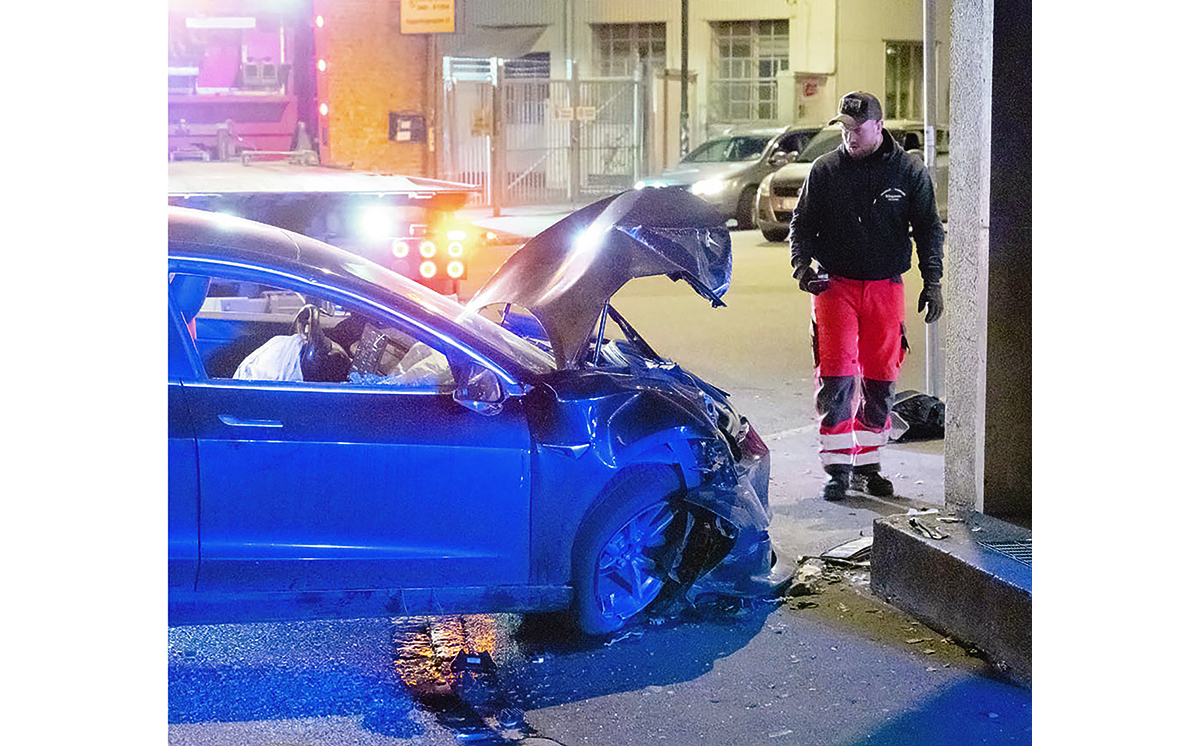
Even with a battery installed, towing an electric car to a defined location is exempt from dangerous goods legislation.
©Foto: Johan Nilsson | picture-allianceThe following situation arises: A lithium-ion battery-powered vehicle (“UN 3556” or “UN 3166”, if hybrid) has had an accident or breakdown. What dangerous goods regulations apply to its transportation?
Transportation by road
Good news for practitioners: The provisions of the international dangerous goods regulations ADR do not apply to the transportation of an accident or breakdown vehicle with dangerous goods (here: with an installed lithium-ion battery) by tow trucks
- if this is carried out by the authorities responsible for emergency response themselves or
- under the supervision of the authorities responsible for emergency response
(subsection 1.1.3.1 d) ADR).
In accordance with 1-5.2 of the German Dangerous Goods Implementation Guidelines RSEB, the determination of the manner of supervision of emergency transportation is the responsibility of the competent emergency management.
Taking into account the actual circumstances, the incident command also determines the safe location and thus the end of the emergency transportation. In cases of emergency transportation, it is therefore a matter of a so-called discretionary decision by the competent authority in individual cases.
Special provisions (SV) 666 and 667 b) and c) ADR apply to both hybrid vehicles (UN 3166) and battery-powered vehicles (UN 3556). SV 666 exempts
- UN 3166 under certain conditions (closure of the „valves“ (No. 3-12 RSEB)
- UN 3556 unconditionally
from the application of the ADR. The transportation of UN 3166 and UN 3556 is therefore not an ADR transport.
Remove the battery?
SV 667 b) and c) ADR regulates two cases:
Case 1: The vehicle with the installed lithium-ion battery is damaged or defective.
The following question must be asked: Does the damage/defect of the vehicle have a significant influence on the safety of the installed battery?
- No: In this case, the vehicle may be transported under SV 666 ADR
- Yes: Is it possible to safely remove the installed battery from the vehicle? If
- no: The vehicle may be transported under SV 666 ADR. This should be the rule. How should a battery weighing 400 to 500 kg be safely removed on site?
- yes: The damaged/defective battery must be transported under special provision 376 ADR. Nobody is likely to do this, because a critically damaged/critically defective lithium-ion battery falls into transport category 0, with all the legal consequences.
Case 2: The battery in the vehicle is damaged or defective. Is it possible to safely remove the battery from the vehicle? If
- no: The vehicle may be transported under SV 666 ADR.
- yes: The damaged/defective battery must be transported under SV 376 ADR.
The transportation of vehicles involved in accidents with a damaged/defective lithium-ion battery is therefore privileged. An example: A recovery vehicle with such a vehicle may drive through all tunnels. A vehicle carrying a removed damaged/defective lithium-ion battery may not drive through category E tunnels.
Carriage by sea and air
Vehicles with damaged or defective lithium-ion batteries may not be transported on seagoing vessels and aircraft (SV 961.1 sentence 4 and 962.4 sentence 2 IMDG Code, packing instruction PI 952 (b) 1. IATA-DGR)
Conclusion
The transportation of vehicles with damaged/defective lithium-ion batteries is a concession to reality.
Dr. Norbert Müller
publicly certified and sworn expert for the transport
and storage of dangerous goods, Duisburg
© Copyright 2026 Gefahrgut-Online

Diskutieren Sie mit