UN 38.3 test: The test summary
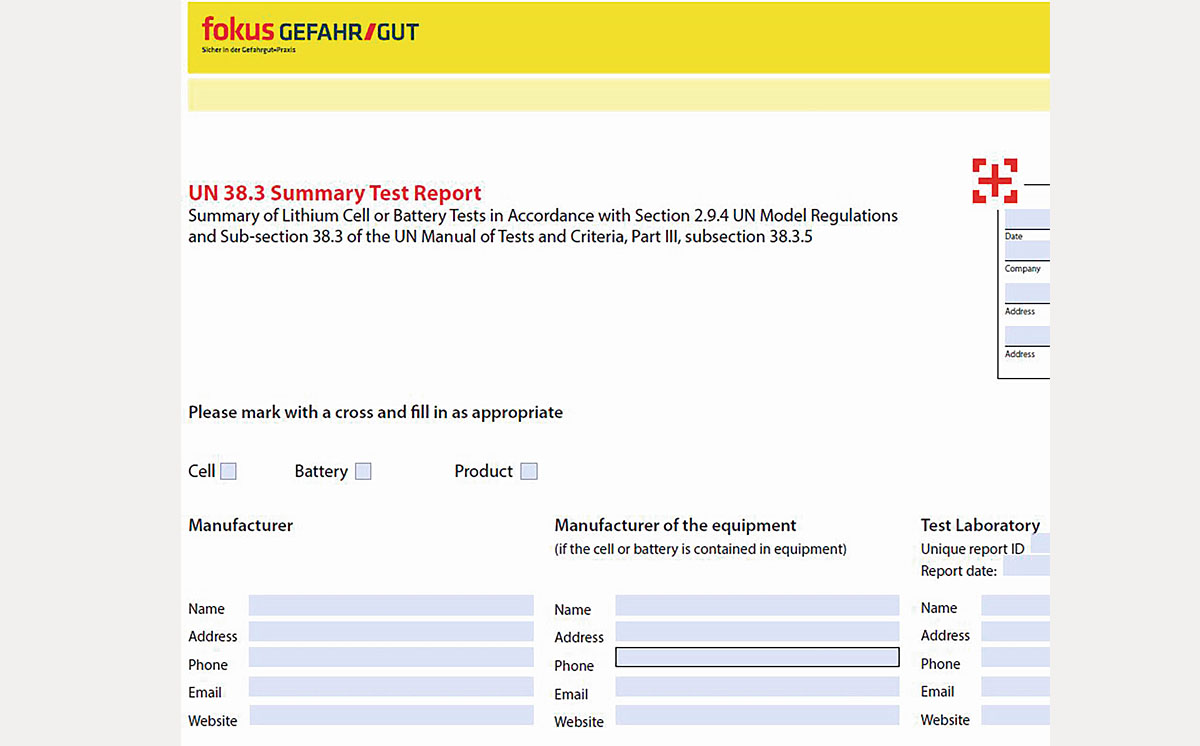
The obligation to provide the summary of the test report can be fulfilled with our sample.
©Foto: fokus GEFAHR/GUT | TECVIA GmbHLithium cells and batteries may only be transported under UN numbers 3090, 3091, 3480 or 3481 if manufacturers and subsequent distributors provide the test summary referred to in section 38.3.5 of the UN Manual of Tests and Criteria. A total of eight tests simulates transportation conditions such as pressure, temperature, crushing or impact. The test summary summarizes the essential data of the report on the testing of the prototype/model of the cell/battery on half a page, as required in section 2.2.9.1. 7 g) in the dangerous goods regulations for land and inland waterway transport (ADR/RID/ADN) or 2.9.4.7 for maritime transport (IMDG Code) or 3.9.2.6.1 (g) for air transport (IATA-DGR) as well as from Special Provision (SV) 230 (ADR/RID/ADN/ IMDG Code). It has been in force since 01.01.2020.
It does not apply to
- prototypes and small series (SV 310 ADR/RID/ADN/IMDG Code or A88 IATA-DGR),
- waste (SV 377 ADR/RID/ADN/IMDG Code or 636 and 670 ADR/RID/ADN) and
- damaged/defective cells/batteries (SV 376 ADR/RID/ADN/ IMDG Code).
Obligations in land transportation
Lithium batteries that do not meet the conditions of special provision 230 are not permitted for transportation (2.2.9.2 ADR/RID/ADN). Dangerous goods may only be transported if their transportation is not excluded in accordance with 2.2.9.2 ADR/RID/ADN (§ 3 of the GGVSEB Dangerous Goods Ordinance). Checking this is the responsibility of the
- Consignor‘s principal (§ 17 (1) No. 1 GGVSEB)
- Consignor (§ 18 (1) No. 3 GGVSEB)
- Shipper (§ 21 (1) No. 1 GGVSEB)
The check is not the responsibility of the carrier (§ 19 GGVSEB).
Obligations in maritime transport
Lithium batteries may only be handed over for carriage on seagoing vessels, loaded onto seagoing vessels or carried on seagoing vessels if the provisions of the IMDG Code are complied with (§ 3 (1) No. 1 GGVSee). The shipper is responsible for checking this (§ 17 No. 1 GGVSee). In this respect, the consignor‘s client, consignor and shipper are obliged
- to check the existence of the test summary in the case of transportation requiring a test summary and
- to refrain from transportation if the test summary is not present.
The
- shipper is obliged to provide the forwarder with all documents required to fulfill his obligations (§ 455 (1) sentence 1 HGB).
- shipper must provide the carrier with all documents required for official handling prior to delivery of the goods (§ 413 (1) HGB).
- charterer shall provide the shipper with all documents required for official processing prior to delivery (§ 487 (1) HGB).
Risks
The fulfillment of the obligations is initially significant under regulatory offense law (§ 37 (1) No. 3 a), 4 c) and 10 a) GGVSEB, § 27 (1) No. 1 a) GGVSee). If someone or something
- is endangered by the transportation of a lithium battery requiring a test summary without a test summary, this is significant under criminal law (§ 328 (3) no. 2 StGB)
- is damaged, this is significant under criminal and liability law:
The
- shipper must, even if he is not at fault, compensate the freight forwarder for damages and expenses caused by the absence, incompleteness or incorrectness of the documents required for the official handling of the goods (§ 455 (2) p. 1 no. 3 HGB). The shipper must compensate the carrier for damages and expenses caused by missing, incomplete or incorrect documents (§ 414 (1) No. 4 HGB), even if he is not at fault.)
- shipper must compensate the carrier for damages and expenses caused by missing, incomplete or incorrect documents (§ 488 (1) sentence 1 no. 4 HGB).
The existence of the inspection summary is also a prerequisite for storage (no. 5.1 German Insurance guideline VdS 3103). Here too, the warehouse keeper should ask his client about this. The depositor is obliged to provide the test summary (§ 468 (1) sentence 2 HGB).Even if he is not at fault, he must compensate the warehouse keeper for damages and expenses caused by missing, incomplete or incorrect documents (Section 468 (3) sentence 1 no. 3 HGB).
Amendment 2025
In 2025, the following is added to all dangerous goods regulations: „The term ‚make available‘ means that manufacturers and distributors ensure that the test summary (...) is accessible so that the consignor and other persons in the supply chain can confirm compliance with the regulations.“
Conclusion
No test summary ➔ no transport, no storage. This should be an established principle, even if it requires effort to implement. The risks are greater.
Prof. Dr. Norbert Müller, publicly certified and sworn expert for the transport and storage of dangerous goods, Duisburg
Test summary online
Sample The obligation to provide the summary of the test report in accordance with the UN Manual of Tests and Criteria Part III, subsection 38.3, paragraph 38.3.5, arises from the international dangerous goods regulations ADR and in Germany from the national dangerous goods regulation GGVSEB and the German Commercial Code (HGB). Subscribers can find samples of the points that need to be recorded in both German and English. The forms can be f illed out electronically on screen.
www.fokus-gefahrgut.de, search „Lithium batteries”
© Copyright 2026 Gefahrgut-Online

Diskutieren Sie mit