E-vehicles involved in accidents: Safe to use
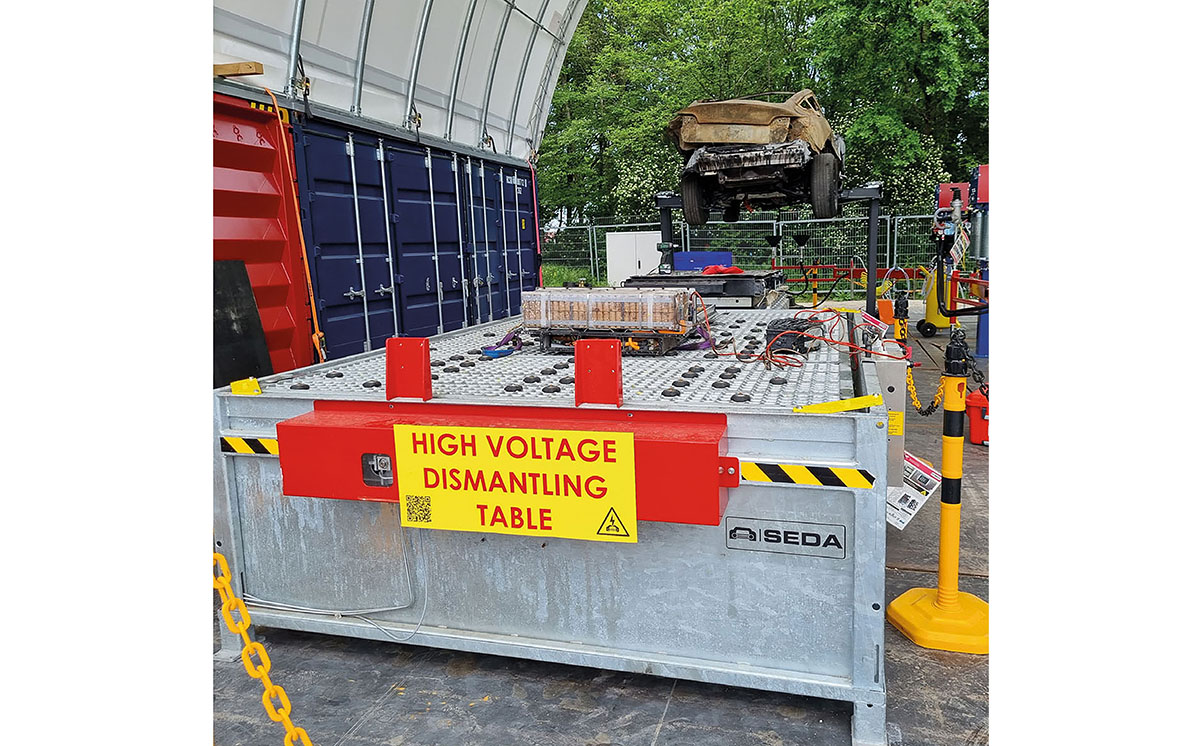
Useful in workshops: specially designed aids such as the cutting table with cooling basin from Seda Umwelttechnik.
©Foto: Daniela Schulte-Brader | TECVIA GmbHIn the event of a breakdown or accident, purely battery-powered electric vehicles and hybrid vehicles pose no greater risk than conventional petrol or gas-powered vehicles, according to the German Social Accident Insurance Institution for the woodworking and metalworking industries (BGHM). Vehicle manufacturers have taken numerous safety precautions to protect vehicle users as well as recovery and workshop personnel. For example, the high-voltage system (HV system) switches off automatically when the airbag is deployed or when the rescue points are severed. In addition, complete galvanic isolation of the HV system from the vehicle body ensures that the latter is not energized.
Level 1, 2 or 3 required
DGUV (German social accident insurance) Information 209-093 ‘Qualification for working on vehicles with high-voltage systems’ specifies the qualifications required by employees of rescue and recovery services in order to work safely with electric vehicles involved in accidents. At least one qualification as a ‘Qualified Instructed Person’ (FuP - 1S) is required. In unclear cases or where there is a potential electrical hazard, a ‘qualified person for high-voltage systems’ (FHV) of level 2S or 3S must be consulted. This also applies if the safety devices or the automatic deactivation of the HV system do not work after an accident or cannot be assessed – for example in the event of a rear-end collision without airbag deployment, serious accidents with fire incidents or severely damaged vehicles.
The towing and recovery team must be specially prepared for the hazards and necessary protective measures at the scene of the accident. The qualifications in accordance with DGUV Information 209-093 are necessary in order to be able to correctly assess these hazards. In addition, employees must observe the vehicle manufacturer‘s specifications and operating instructions when towing and recovering.
Repairs that go beyond towing must be carried out by an FHV in a suitable workshop.
Numerous training providers
These qualifications and knowledge are based on DGUV Regulation 1 ‘Principles of prevention’ and DGUV Regulation 3 ‘Electrical systems and equipment’ in order to prevent accidents at work in connection with high-voltage vehicles involved in accidents.
Lars Kopka from the German Social Accident Insurance Institution for the woodworking and metalworking industries (BGHM) emphasises in the press release that the 1S, 2S and 3S qualifications in accordance with DGUV Information 209-093 are offered by numerous training providers throughout Germany. These qualifications authorise the holder to work independently on high-voltage vehicles, meaning that employees of recovery and towing services are also optimally prepared for working on electric vehicles involved in accidents.
Daniela Schulte-Brader
© Copyright 2026 Gefahrgut-Online

Diskutieren Sie mit