Storage: Many parameters
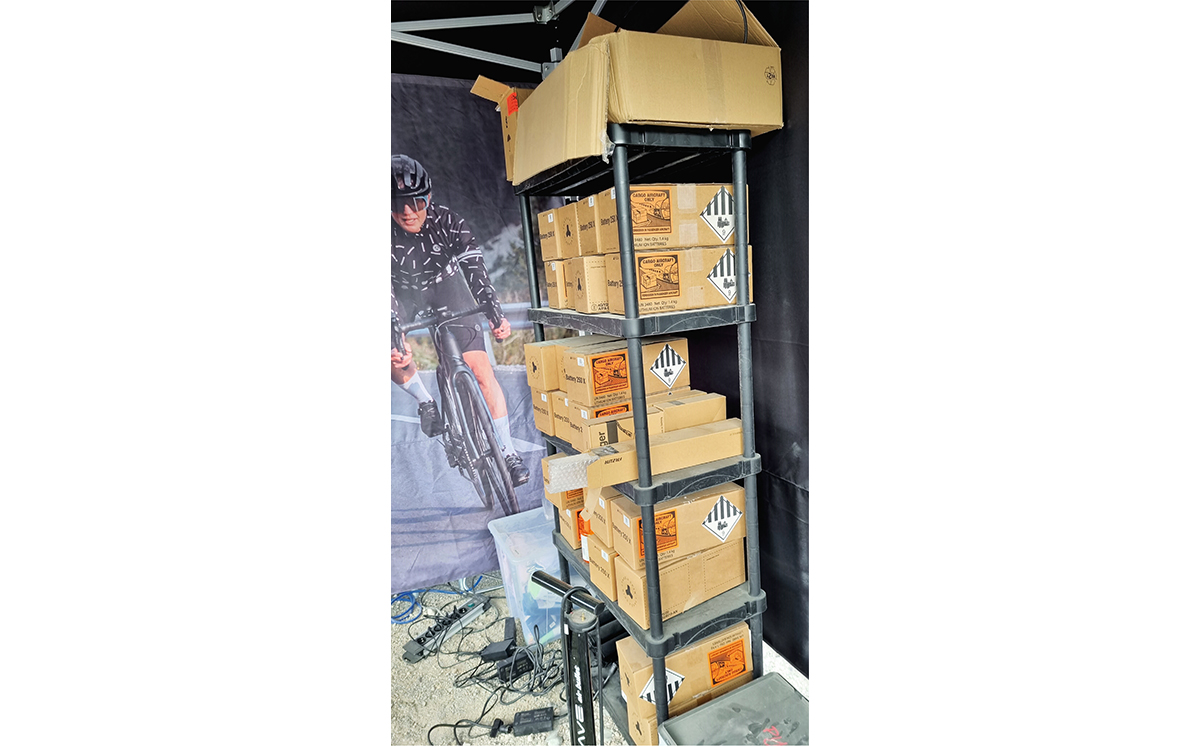
The requirements for storing lithium-ion batteries must be clarified on a case-by-case basis. If necessary, it may be worth purchasing a safety cabinet (see survey "Lithium batteries: Packaging").
©Foto: D. Schulte-Brader | TECVIA Media GmbHThere is still no closed concept for the storage of lithium-ion batteries in Germany. Instead, there is a patchwork of regulations, which causes uncertainty for all parties involved, i.e. investors in logistics properties, planners, authorities, operators, auditors, and insurers.
And uncertainty is what is least needed with lithium batteries, especially when it comes to storage. The following is therefore a “cash check” of the existing regulations.
In 2022, 17,800 tons of lithium-ion and metal portable batteries were placed on the market in Germany. This quantity must be transported and generally also (temporarily) stored on the way from the manufacturer to the consumer.
The quantity of lithium-ion industrial batteries (HV batteries for electromobility) placed on the market is estimated at 200,000 tons. Recycling companies in Germany counted around 10,000 tonnes of lithium-containing device, industrial and vehicle batteries returned in 2023.
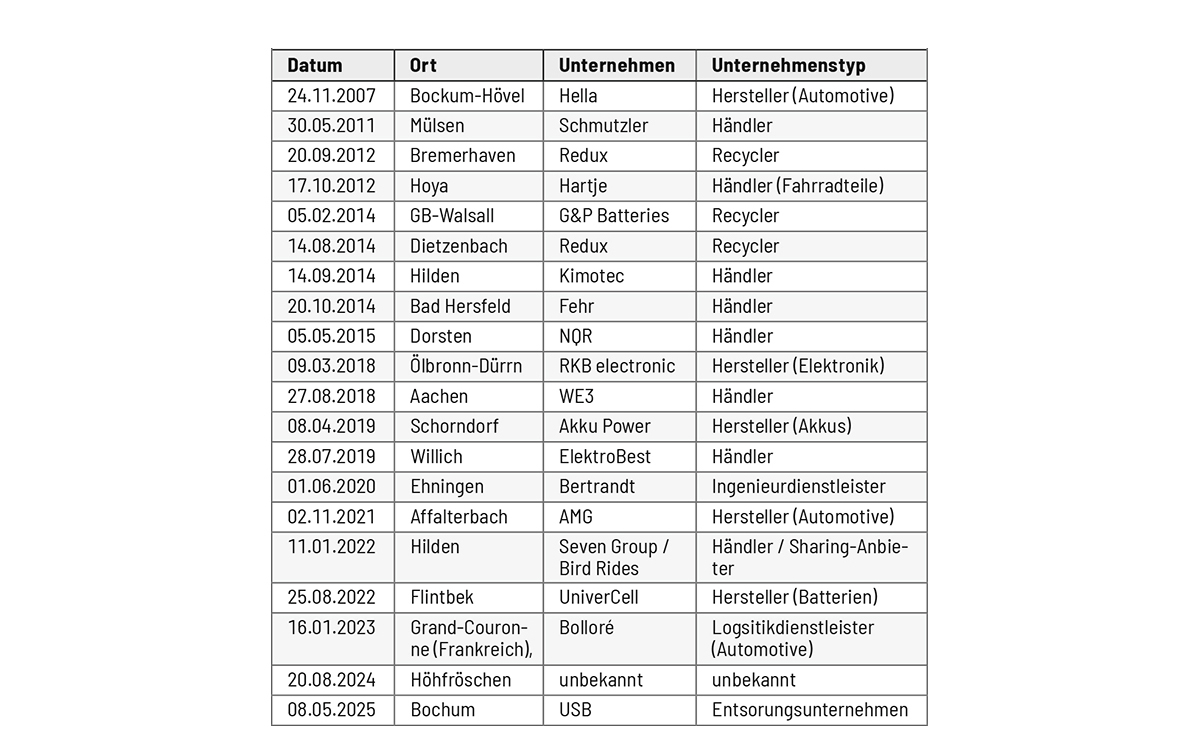
Table: Major fires involving lithium batteries (selection)
©Foto: TECVIA Media GmbHBuilding law
A building whose use involves the storage of substances with an increased fire risk, such as lithium-ion batteries, is a so-called special building under building law. This assumption applies in all German federal states except Hesse.1)
Are lithium-ion batteries substances with an increased fire risk? The incidence of fire in lithium-ion battery storage and disposal facilities (see Table above) suggests the answer “yes”.
However, there is no substance-specific quantity limit. A guide: For spray cans and liquids with a flash point of less than 23 degrees Celsius, a net storage quantity of 200 kilograms triggers the special construction status. The
- construction of a new warehouse and the
- change in the use of an existing warehouse for the storage of lithium-ion batteries
require planning permission. This is important for existing facilities that are to be repurposed. Special buildings must always be separated from adjacent rooms in a fire-resistant manner (“F/T 90”).
In individual cases, special requirements may be imposed on special buildings to meet the general requirements. These special requirements may extend to
- fire protection systems, equipment, and precautions as well as
- the retention of extinguishing water.
For special buildings, a fire protection concept must be submitted together with the building documents. This concept must clarify in particular
- the separation of adjacent rooms: walls, ceilings and doors: fire-resistant design (F/T 90).
- Limitation of the fire load by area and quantity. For liquids with a flash point ≤ 60 °C, a maximum of 100 tons may be stored in a fire compartment. Some fire protection planners are guided by this limit.
- Automatic fire alarm system
- Automatic fire extinguishing system. Fire and extinguishing tests have shown that only water helps, CO2 does not.
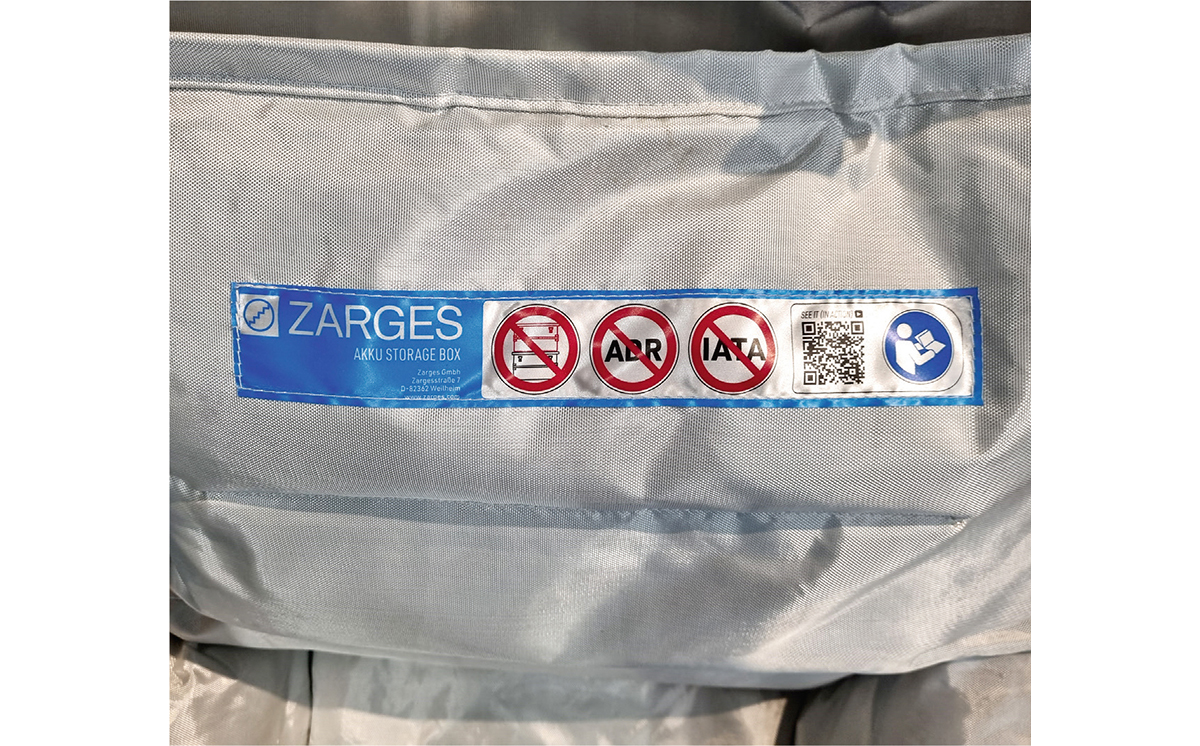
Not stackable and not suitable for use as transport packaging, but ideal as storage containers: container and packaging suppliers have expanded their portfolios accordingly (see survey "Lithium batteries: Packaging for critically damaged batteries").
©Foto: D. Schulte-Brader | TECVIA Media GmbHA distinction must be made between
a) Block storage
- What is the maximum number of pallets that may be stacked?
- What is the maximum height of a block?
- What is the maximum contiguous area that may be occupied?
- What is the minimum distance in meters between the areas?
b) Rack storage
- Extinguishing water retention
- Cold storage, thermography
- Prohibition of combined storage
Handling damaged/defective batteries (quarantine area outside)
Water law
Lithium-ion batteries are so-called products. Does the German Ordinance on Installations for the Handling of Substances Hazardous to Water (AwSV) also apply to products? The German Federal Ministry for the Environment says: yes.
What water hazard class (WHC) do lithium batteries have? The Federal Environment Agency says: This must be assessed based on the substances contained. Example: Lithium-ion battery contains at least 0.3 percent cobalt oxide (Chemical Abstract Service 1307- 96-6, WHC 3, M-factor 10): The lithium-ion battery is WHC 3.
The AwSV states: if lithium-ion batteries are
- articles: The AwSV does not currently contain any specific requirements for articles.
- solid mixtures: The AwSV currently categorizes solid mixtures as generally hazardous to water. However, a change is planned: In future, the WHC of a solid mixture is to be determined based on the ingredients, as is the case with liquid and gaseous mixtures.
Extinguishing water retention
The legal situation is currently confusing: Building law in the form of the German Extinguishing Water Retention Directive (LöRüRL) prescribes – or rather prescribed: the storage of more than
- 100 tons of WHC 1
- 10 tons of WHC 2
- 1 ton of WHC 3
requires the retention of extinguishing water.
BUT: All federal states have withdrawn the LöRüRL. Water legislation in the form of the AwSV stipulates the retention of extinguishing water when storing.
- currently > 200 kilograms of solid mixtures hazardous to water,
- planned > 5 tons.
And again BUT: Building law in the form of the BauO prescribes a fire protection concept for special buildings, and the retention of extinguishing water is a mandatory topic.
For facilities for the storage, handling, manufacture, treatment and use of lithium-ion batteries, the Federal-Working Group ‘Handling substances hazardous to water substances’ has published the information sheet ’Handling lithium-ion batteries according to the AwSV’ (status: 29/05/2024, 24 pages). In it, lithium-ion batteries are included in the scope of the AwSV although they are products. The information sheet was presented in fokus GEFAHR/GUT 12/2024 and is available online.
Chemicals law
Lithium batteries are not hazardous substances according to the Hazardous Substances Ordinance (GefStoff V). This means: They do not fall within the scope of the - EU CLP V - EU REACH V - GefStoffV, also not in the Technical Rule Hazardous Substances 510, but in TRGS 520 (No. 6.3.4 (6) Page 2 Line 2).
The 2012 edition of the German Technical Regulation for Hazardous Substances (TRGS) 520 on the temporary storage of hazardous waste has been replaced by the July 2024 edition. The training course for the acquisition of specialist knowledge now includes three teaching units specifically for the acceptance and handling of waste lithium batteries, especially defective ones.
The storage of spent lithium batteries in the storage area of interim storage facilities is now in a separate storage section (‘IV’).
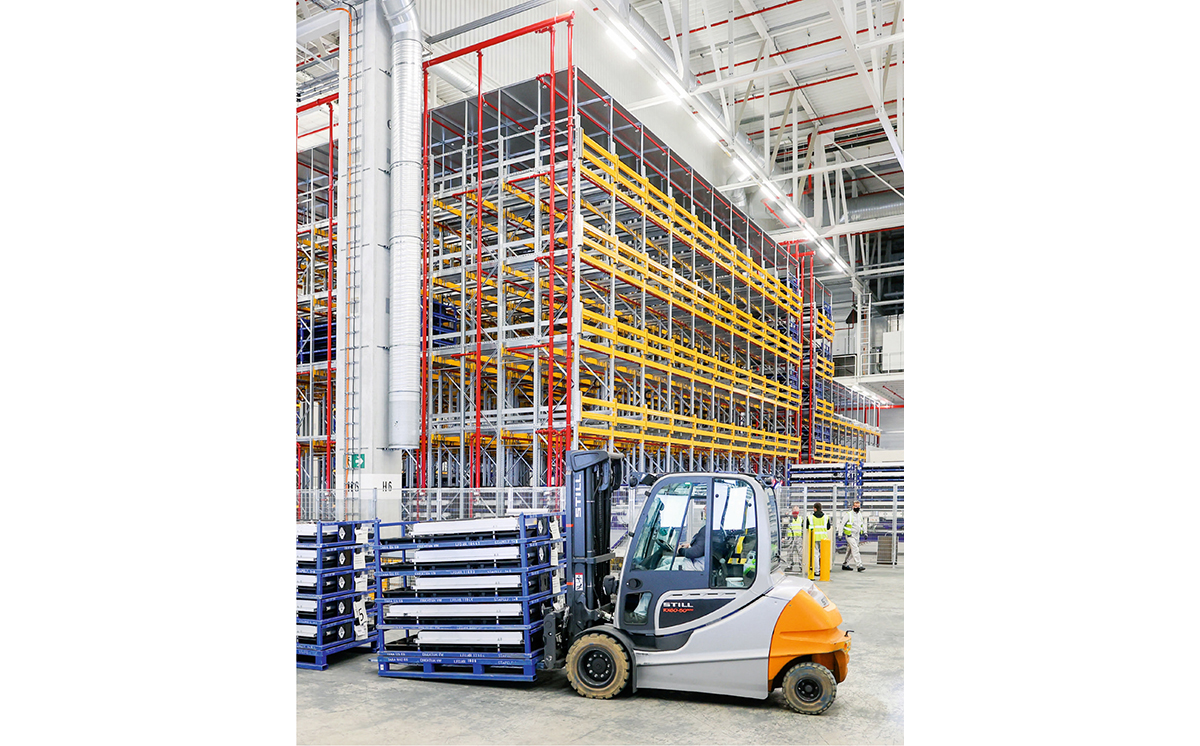
Batteries for electric vehicles produced on a large scale are stored and transported unpackaged in metal load carriers.
©Foto: Jan Woitas | picture-allianceInsurance contract law
Why should the policyholder be interested in the insurer’s specifications?
Reasons are:
New conclusion: Before submitting his contract declaration, the policyholder must inform the insurer of the dangerous circumstances known to him that are significant for the insurer’s decision to conclude the contract with the agreed content and about which the insurer has asked in text form.
Change of use: After submitting his contractual declaration, the policyholder may not increase the risk or allow a third party to do so without the insurer’s consent. If the insured event occurs after an increase in risk, the insurer is not obliged to pay if the policyholder has intentionally breached his obligation.
In the event of a grossly negligent injury, the insurer is entitled to reduce its benefit in proportion to the severity of the policyholder’s fault; the policyholder bears the burden of proof for the absence of gross negligence.
If the contract stipulates that the insurer is not obliged to pay in the event of a breach of a contractual obligation to be fulfilled by the policyholder, it is exempt from payment if the policyholder is entitled to pay in the event of a grossly negligent breach of the obligation to reduce the amount in proportion to the severity of the policyholder‘s fault.
The policyholder bears the burden of proof that there was no gross negligence. So that the policyholder is not left with a loss, he should know his obligations towards the insurer.
German non-life insurers
In the absence of government regulations, the non-life insurers in the Association of Property Insurers (VdS) have, for understandable reasons, addressed the issue of “storage of lithium-ion batteries” for a long time as follows: since
- 2012 with the information sheet “Lithium Batteries” (VdS 3103)
- 2019 with the leaflet “Sprinkler protection of lithium batteries” (VdS 3856). Both leaflets are also available in English.
For the storage of lithium-ion batteries, the VdS has published the VdS CEA 4001 and VdS 3103 and 3856, VdS has published the technical data sheet ‘Lithium-ion batteries’ (as of February 2024, 6 pages) has been published.
This is a modified version of the modified version of the Technical Bulletin ‘Li-Ion Batteries’ from Insurance Europe (September 2022), in particular with regard to the permissible sprinkler types (K-factors) and the permissible state of charge of the stored batteries.’
European non-life insurers
In September 2022, the “Insurance Europe” association (IE, formerly: Comité Européen des Assurances CEA) presented an addition to the guideline “Sprinkler systems: planning and installation” (CEA 4001) in the form of a technical bulletin “Lithium-ion batteries” (TB 003).
Factory Mutual (FM) Global
In October 2024, the US industrial insurer FM Global summarised its requirements for the storage of lithium batteries in a new data sheet 7-112.
The storage of batteries is clearly structured across different sections to ensure safety and compliance. Section 2.4.3 outlines the guidelines for storage in “small storage areas” (max. 20 m² in size and a storage height of up to 1.8 m). Section 2.4.5 focuses on the storage of both new and reconditioned batteries, with specific regulations for block storage and shelf storage.
For returned, faulty, damaged, or defective batteries, you will find the relevant rules in Section 2.4.6. Section 2.4.7 covers the regulations for automatic shelf storage, while Section 2.4.4 provides guidance on the storage of batteries installed in appliances. Each section ensures a clear and comprehensive framework for safe and efficient battery storage.
A further requirement is:
- Precautionary plan regarding the handling of hand fire extinguishers and the designation of an area outside the building for damaged/defective batteries.
- Aftercare plan regarding possible re-ignition, fire station and disposal of damaged/defective batteries (arrangement with disposal company).
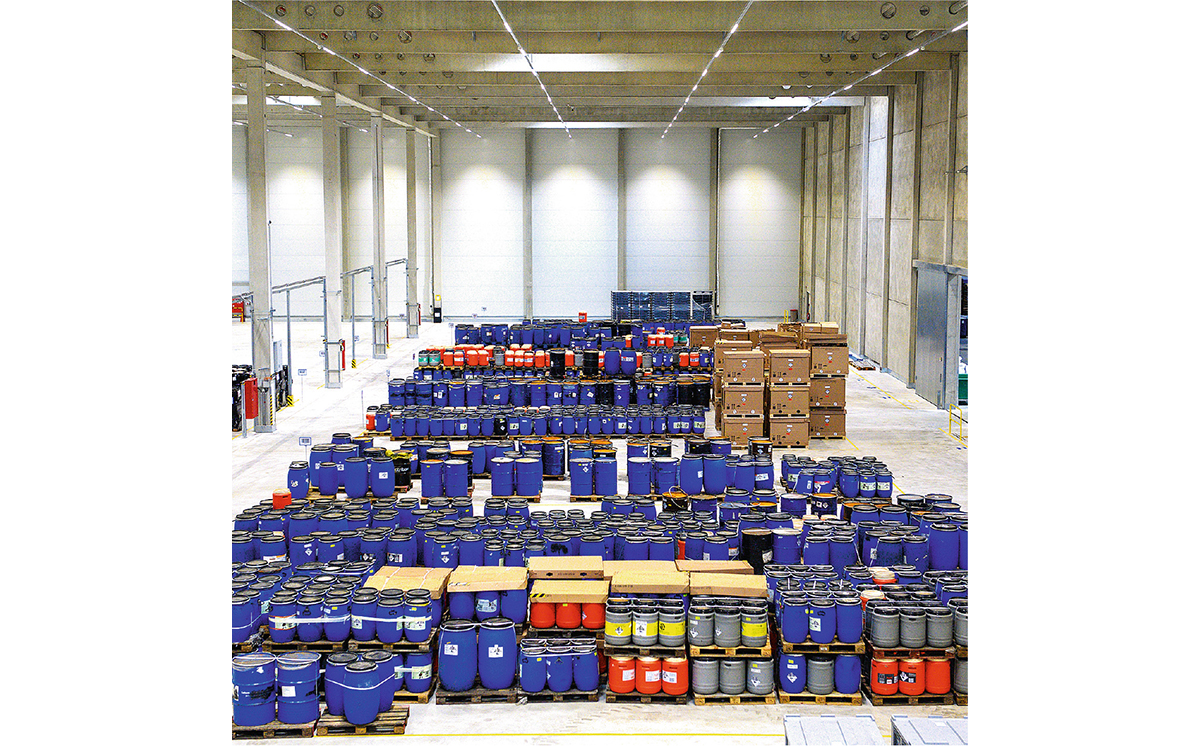
Lithium batteries are stored in all stages. The requirements for this must be clarified individually.
©Foto: Klaus-Dietmar Gabbert | picture-allianceComparison: Solid pile and rack storage
Solid pile storage: Table 5 on this page compares the sprinkler protection requirements of VdS, IE/CEA and FM Global using the example of storing lithium-ion batteries, each > 100-watt hours, each > 12 kg gross, in solid pile storage.
Rack storage: Table 6 compares the sprinkler protection requirements of the property and industrial property insurers VdS, IE/CEA and FM Global using the example of storing lithium-ion batteries, each > 100-watt hours and each > 12 kg gross, in racks.
Special cases
Just for the sake of completeness: The storage of
- used and/or damaged/defective lithium-ion batteries
- lithium-ion batteries in devices
- lithium metal batteries
is not a standard and requires separate consideration.
News for fulfilment and logistics service providers
Since 7 October 2025, the new German Battery Act (BattDG) has required fulfilment service providers to actively take responsibility for the legally compliant return and disposal of batteries: “If a battery manufacturer (or its authorised representative) is not registered or is not properly registered, fulfilment service providers may not
- store
- package
- address
- ship
batteries from this manufacturer.”
A ‘fulfilment service provider’ is any natural or legal person who offers at least two of the following services as part of their business activities:
[ ] Storage
[ ] Packaging
[ ] Addressing
[ ] shipping
of batteries.
Logistics service providers offering services such as storage, packaging, addressing and/or shipping of batteries in Germany are required by the BattDG to verify that the manufacturers of the batteries they store, package, address and/or ship are properly registered with the German Stiftung Elektro-Altgeräte-Register (ear) in Nuremberg (www.stiftung-ear.de/verzeichnisse/).
This also applies to batteries that are installed in products (devices, vehicles) or included with products (devices/vehicles). For example, in the case of an e-bike, this means that
- both the manufacturer of the e-bike (in accordance with ElektroG)
- and the manufacturer of the battery in/on the e-bike must (in accordance with BattDG)
be registered with ear.
New administrative offence
Logistics service providers who store, package, address or ship batteries for manufacturers must ensure that these manufacturers are properly registered with the Stiftung Elektro-Altgeräte-Register (ear) in Nuremberg.
If this registration is missing, the service provider is acting unlawfully – and that can be expensive: fines of up to € 100,000 are possible.
Conclusion
It remains the state’s responsibility to ensure that the storage of lithium batteries becomes a calculable risk – for everyone involved.
Dr. Norbert Müller,
Publicly certified expert for the transport and storage of dangerous goods, Duisburg
Footnote:
1) Section 2 (9) No. 17 of the Hessian Building Code was deleted in 2018; Reason: Such systems would require approval according to the BImSchG, and therefore would be no need for additional building regulations requirements (Hessischer Landtag printed matter 19/5379, here p. 70).
© Copyright 2026 Gefahrgut-Online

Diskutieren Sie mit